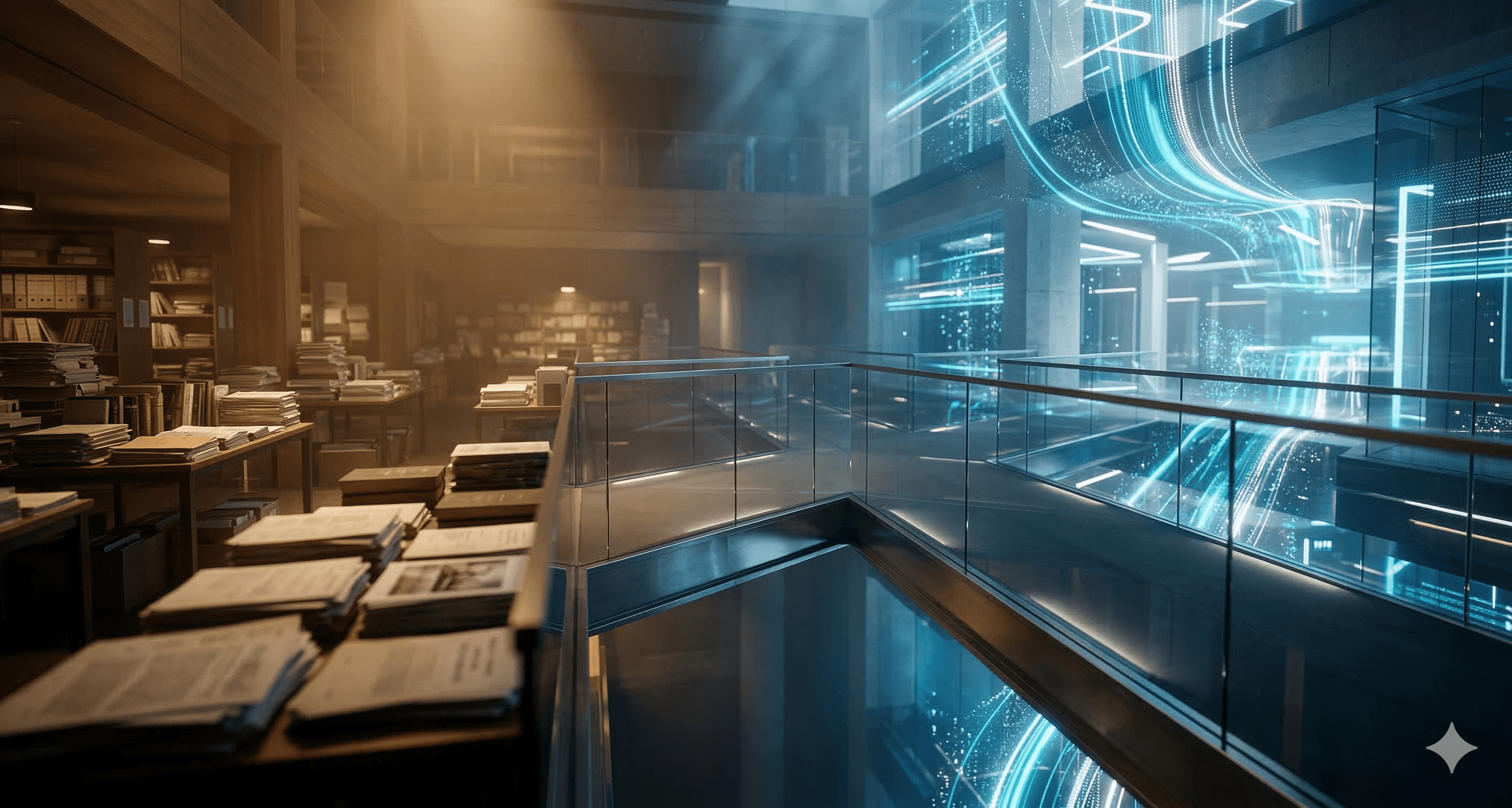
Last week I needed to produce a client presentation. The thinking was done. The strategy was sharp. All the content existed inside my AI environment, structured and current. In previous articles I've described this as the AI world, where information moves at machine speed.
Then I needed a PowerPoint. And for a moment, everything slowed down.
This is where most people's AI workflows stall. Not during the thinking. Not during the research or the analysis or the structuring. During the last mile. The point where work has to cross from the AI world back into the human world. Into the formatted deck. The polished report. The email that looks right.
That crossing is friction. And most people don't even recognise it as a problem because they've never experienced the alternative.
I've written about keeping your work in the AI world as long as possible because that's where the 10x speed lives. But every project eventually needs a human-world output. A deck for a client. A report for the board. The question isn't whether you'll cross the boundary. It's how much that crossing costs you.
For most people, it costs a lot. All the speed they gained in the AI world evaporates in the production phase. That's not an AI problem. It's an infrastructure problem. They're wading across the river every time instead of building a bridge.
Here's what building a bridge looks like.
Most of your existing knowledge is trapped. It's sitting in slide decks and PDFs designed for human eyes. Beautifully formatted. High-friction for AI. The models can read them, but not at the speed or depth they can work with when information is in their native format. The first move is to close that gap.
Take your key materials and ask AI to study them. Not just to extract the text, but to understand the substance. The current models can look at a chart on a slide and capture what it communicates. They can read a formatted report and distil the content into clean, structured information the AI can work with natively. Once that content lives in the AI world, it has velocity.
But don't stop at extraction. Ask AI to produce a formatting guide as well. How your presentations are structured. The layout patterns. The conventions. Now you've got both the raw material and the production rules living in the AI world.
The result: whenever I need a new deck, I tell the AI what it needs to cover, point it at the project context it already has, and tell it to use the formatting guide. It produces a polished draft in minutes. Not a rough outline I then spend two hours prettifying. A proper draft, in my style, ready for me to review and refine.
The first time I set that up took some effort. Every time after that has been nearly free. That's the principle. Build the bridge once, cross it forever.
There's an even more powerful pattern, though. Sometimes you can eliminate the crossing entirely.
When I was building software last year, most of my time wasn't spent on the code. The AI wrote code fast. My time went to deploying the application, testing it in a browser, finding errors, copying the error messages back to the AI, waiting for a fix, then doing it again. I was the middleman between the AI world and the human world, shuttling information back and forth manually. The AI was fast. The loop was slow. Because I was in the loop.
So I set it up so the AI could run a browser itself. Test its own code. See its own errors. Fix them without me in the middle. The crossing didn't get faster. It disappeared. The entire loop now runs at machine speed, and I only step in when it needs my judgment about what to build next.
That's a different kind of friction reduction. The formatting guide makes the crossing smooth. This one asks a sharper question: does this crossing need to exist at all?
There's one more pattern, and it might save the most time of all. Invest heavily in specification before you build.
I'm working on a new feature right now, and before writing a single line of code I spent a bit more time upfront getting the specification right. Using different AI models to explore approaches, challenging assumptions, mapping out how the feature will come to life and what tools it should use. Particularly for tooling decisions. I'm evaluating audio and video frameworks for this project, and swapping those out later would mean undoing significant amounts of work. So I do the research now. A small upfront investment that saves ten to twenty times its cost later.
This is friction prevention rather than friction reduction. If you start building from a vague brief, you're guaranteeing expensive rework loops. Every time the output isn't what you wanted, that's another crossing. Another round of back-and-forth. Another cycle of "no, not like that, like this." By the time you've iterated your way to the right answer, you've crossed the boundary dozens of times.
A detailed specification, built collaboratively with AI before the building starts, gives the AI a rich, precise target. The first output is closer to what you want. The rework loops shrink. Some disappear entirely. The upfront investment pays for itself many times over.
Most people never think about their AI workflow this way. They accept the friction as a given. Of course you have to manually format the slides. Of course you copy the error messages. Of course you iterate endlessly because the brief was vague. That's just how it works.
It's not. Liberate your trapped information. Build reusable bridges for recurring outputs. Eliminate crossings where AI can handle both sides. And specify precisely before you build. Each one compounds. And the AI world keeps expanding as models get better, which means crossings you automated last month might not need to exist at all next month.
Start by noticing where your time actually goes. Not the thinking. Not the strategy. The production. The formatting. The rework. The translating between worlds. That's where your friction lives.
Build the bridge once. Better yet, ask whether the bridge is even necessary.
Your move, human.